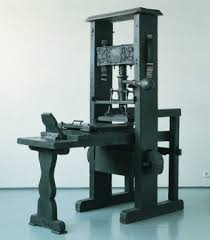
A printing press, in its classical form, is a standing mechanism, ranging from 5 to 7 feet long, 3 feet wide, and 7 feet tall. Type, or small metal letters that have a raised letter on each end, is arranged into pages and placed in a frame to make a forme, which itself is placed onto a flat stone, 'bed,' or 'coffin.' The text in inked using two pads mounted on handles. These pads were stuffed with sheeps wool and were inked. This ink was then applied to the text evenly. One damp piece of paper was then taken from a heap of paper and placed on the tympan. The paper was damp as this lets the type 'bite' into the paper better. Small pins hold the paper in place. The paper is now held between a frisket and tympan (two frames covered with paper or parchment). These are folded down, so that the paper lies on the surface of the inked type. The bed is rolled under the platen, using a windlass mechanism. A small rotating handle is used called the 'rounce' to do this, and the impression is made with a screw that transmits pressure through the platen. To turn the screw the long handle attached to it is turned. This is know as the bar or 'Devil's Tail.' Then the screw is reversed, the windlass turned again to move the bed back to its original position, the tympan and frisket raised and opened, and the printed sheet removed. Such presses were always worked by hand. After around 1800, iron presses were developed, some of which could be operated by steam power.

No comments:
Post a Comment